
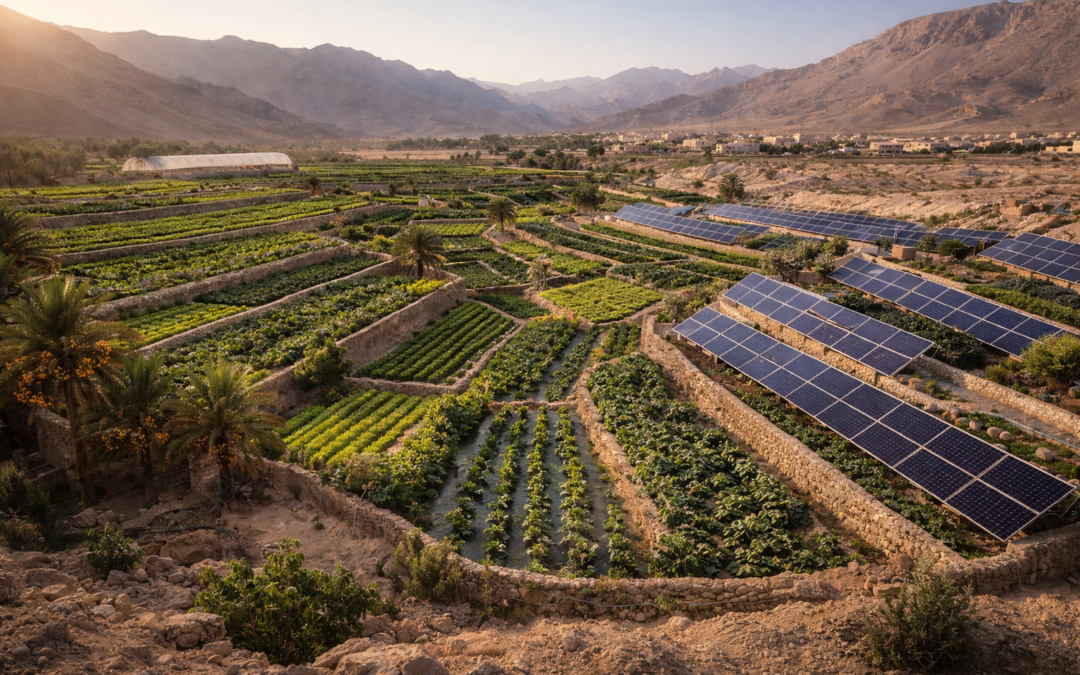
Agricultural practices across Oman are being disrupted and transformed through the adoption of innovative technological solutions created to increase the Sultanate’s self-sufficiency. Launched in 2019 through a collaboration between Sohar University and the University of Sheffield in England, the Grow Dome project in Sohar employs solar-powered desalination and soilless farming to convert saline water into freshwater for agriculture purposes.
Seawater farming is a game-changing agricultural technique that relies on seawater for irrigation, enabling farmers to grow crops even in arid regions. Also known as saline agriculture, the technique addresses freshwater scarcity, environmental sustainability, and food security simultaneously, paving the way for the production of salt-tolerant plant species, known as halophytes. Crops that are naturally resistant to high salinity include barley, quinoa, spinach, and kale, all of which thrive when irrigated with a mix of salt and freshwater. In addition to making precious freshwater resources go further by promoting sustainable agricultural methods in saline environments, seawater farming goes a long way toward improving soil structure and quality.
An ideal location for seawater farming
Boasting an extensive coastline and arid climate, Oman is ideal for seawater farming. Through the integration of agriculture and aquaculture in coastal regions, Oman can create a circular economy, with fish farming providing nutrient-rich water for crops. This process could further be enhanced by solar desalination technologies, thereby conserving precious freshwater resources in a part of the world where rainfall is scarce. Local entrepreneurs are innovating the farming sector through the introduction of bio-bricks and bio-composites from salt-tolerant plants, supporting sustainable construction practices. This relatively new market sector is creating significant opportunities for innovative startups and small businesses, boosting employment among Omanis and spurring the wider economy.
This approach aligns with Oman’s Vision 2040, which focuses on sustainable development and reduced environmental impact. Seawater farming will not only improve food security in the country, but drive economic growth, creating jobs while simultaneously contributing to environmental sustainability, paving the way for a more prosperous and resilient future for Oman.
Solar-powered desalination
Established through a 2004 pilot project with Sultan Qaboos University, the Seawater Greenhouse project marked a major step forward in saline agriculture. The project replicates the hydrologic cycle by evaporating saline water, then capturing it as freshwater in the form of condensation. In the United Arab Emirates, the technology has enabled farmers to cultivate fruits and vegetables using solar-powered desalination.
For countries all over the world today, agriculture is a vital sector that contributes significantly towards economic growth and development. According to a 2022 report from the World Bank, farming accounted for a quarter of the GDP in developing countries, on average. However, in Oman in 2021, the World Bank suggested that just 4% of the total population was employed in agriculture in 2021, with the sector accounting for just 2% of the sultanate’s GDP.
The emergence of vertical farming
Currently, the world is facing various environmental and socio-economic problems: major issues that require urgent attention. According to the UN Food and Agriculture Organization (FAO), food insecurity is a rising problem, along with poverty, climate change, and rising populations. However, food production can be boosted significantly through proper planning and the integration of innovative technologies in agriculture, the FAO suggests. Sustainable agriculture is integral to meeting rising demand for food production in Oman, enabling it to feed a rising population and reduce dependence on foreign food imports. One effective means of achieving this is through vertical farming.
A recent study examined the potential of vertical farming to boost self-sufficiency and economic growth in Oman. In recent decades, the global vertical farming market has witnessed considerable growth, driven by an expanding population and advancing urbanization, leading to a surge in opportunities in many regions. Vertical farming has emerged as an effective solution to mounting global food insecurity. Valued at $5.6 billion in 2022, the global vertical farming sector is tipped to reach $35 billion by 2032.
A game-changing solution
In Middle Eastern countries such as Oman, experts cite vertical farming as a potentially game-changing solution to rising food production demands, the sector having gained substantial momentum in neighboring nations. Boasting excellent infrastructure for electricity generation, as well as a generous land area, Oman’s strategic location positions it an ideal regional hub for agricultural innovation. Research suggests that vertical farming startups hold vast potential for profitability and sustainability in the country. While the initial investment may be high, experts suggest that as technology advances and market dynamics evolve, vertical farming, like seawater farming, will soon establish itself as a cornerstone of urban agriculture in Oman.
Smart farming is rapidly gaining traction across Oman as part of national strategies to ensure sustainability and efficient resource management. Also known as precision farming, smart agriculture is fueled by data-driven solutions such as the Internet of Things, drones, sensors, AI-powered analytics, and climate monitoring systems to manage farms more efficiently. As global temperatures continue to rise and usable tracts of arable land begin to shrink, forward-looking governments like the Sultanate of Oman are leveraging the power of innovative technology to enhance agricultural output and reduce reliance on foreign imports.